The Ultimate Guide to Crafting High-Ranking Content for Google SEO
In the ever-evolving digital landscape, standing out online requires more than just publishing content; it demands publishing high-ranking content for Google SEO. Every business, blogger, and digital marketer shares the common goal: to appear at the top of Google’s search results. Achieving this isn’t a stroke of luck; it’s the result of a deliberate, strategic approach to content creation that aligns perfectly with Google’s algorithms and, more importantly, user intent.
This ultimate guide will break down the essential strategies and tactical steps needed to consistently produce content that Google loves and users find invaluable, ensuring your pages dominate the SERPs.
Understanding Google’s Algorithm and User Intent
Before you can create content that ranks, you must understand what Google prioritizes. Google’s primary mission is to deliver the most relevant and helpful results to its users. This means your content needs to be:
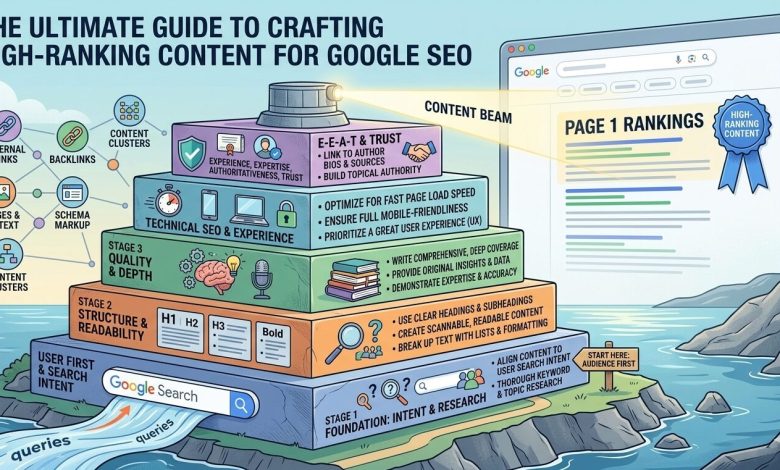
- Expertise, Experience, Authoritativeness, and Trustworthiness (E-E-A-T): Google heavily emphasizes the quality and credibility of content creators and their sources. Demonstrate deep knowledge and real-world experience.
- User-Centric: With updates like the “Helpful Content System,” Google is penalizing content written primarily for search engines and rewarding content created for people.
- Optimized for Core Web Vitals: Page experience metrics (loading speed, interactivity, visual stability) are crucial for user satisfaction and, consequently, ranking.
At the heart of crafting high-ranking content lies understanding user intent. What exactly is the user hoping to find when they type a query into Google? There are typically four main types of search intent:

- Informational: Users seeking answers to questions (e.g., “how to bake sourdough”).
- Navigational: Users looking for a specific website or page (e.g., “YouTube login”).
- Transactional: Users intending to buy something (e.g., “buy noise-cancelling headphones”).
- Commercial Investigation: Users researching products or services before buying (e.g., “best laptops for graphic design”).
Your content must perfectly match the intent behind the keywords you’re targeting. Mismatched intent is a primary reason why content fails to rank, even if it’s otherwise well-written.
Strategic Keyword Research: The Foundation of High-Ranking Content
Effective keyword research is the bedrock upon which all high-ranking content for Google SEO is built. It’s about more than just finding terms with high search volume; it’s about uncovering opportunities where your content can truly shine.
Go Beyond Basic Keywords
- Long-Tail Keywords: These are longer, more specific phrases (e.g., “best vegan protein powder for muscle gain”). They often have lower search volume but higher conversion rates and less competition.
- Semantic Keywords (LSI Keywords): These are related terms and synonyms that help Google understand the broader context of your content. If your primary keyword is “coffee maker,” semantic keywords might include “espresso machine,” “drip brew,” “bean grinder,” or “caffeine.”
- Question-Based Keywords: People often use Google to ask questions. Tools can help you identify common “how,” “what,” “why,” and “when” questions related to your topic.
Competitor Analysis
Analyze your top-ranking competitors. What keywords are they ranking for? How are they structuring their content? This doesn’t mean copying, but rather identifying gaps and opportunities to create even better, more comprehensive content.
Mapping Keywords to Content
Once you have a list of targeted keywords, map them to your content ideas. Each piece of content should ideally target a primary keyword and several secondary or long-tail keywords, all aligned with a specific user intent. This strategy is crucial for **SEO content writing** that yields results.
Developing SEO-Optimized Content That Delivers Value
Once your keyword strategy is solid, the next step is to create the content itself. This involves a blend of persuasive writing, strategic SEO implementation, and a commitment to providing genuine value.
Content Structure and Readability
Google and users both appreciate well-organized content.
- Clear Headings: Use `<h2>` and `<h3>` tags to break up your content, making it scannable and digestible. Your primary keyword should appear in your `<h1>` and ideally in at least one `<h2>`.
- Short Paragraphs: Large blocks of text can be intimidating. Keep paragraphs concise, typically 2-4 sentences.
- Bullet Points and Numbered Lists: These improve readability and help users quickly grasp key information, making your content more “snackable.
- Engaging Introduction: Hook your readers immediately and clearly state what they will learn.
- Comprehensive Conclusion: Summarize key takeaways and provide a clear call to action.
On-Page SEO Elements
These are the foundational technical elements that tell Google what your page is about.
- Title Tag (`<title>`): This is arguably the most important on-page element. Include your primary keyword near the beginning and keep it concise (under 60 characters). Make it compelling.</li>
- Meta Description:While not a direct ranking factor, a well-written meta description can significantly improve click-through rates (CTR) from the SERPs. Include your primary keyword and a strong call to action.</li>
- URL Structure: Keep URLs short, descriptive, and include your primary keyword (e.g., `yourwebsite.com/ultimate-guide-high-ranking-content`).
- Image Optimization: Use descriptive file names and `alt` text for all images. This helps with accessibility and provides more context to search engines.
- Keyword Density and Placement: Naturally integrate your primary and secondary keywords throughout the content. Avoid keyword stuffing; focus on natural language and context.
Content Quality and Depth
Google’s updates consistently reward content that is genuinely helpful and comprehensive.
- Answer All Questions: Aim to be the definitive resource on your chosen topic. Anticipate follow-up questions and address them within your article.
- Accuracy and Freshness: Ensure your information is current and factually correct. Regularly update older content to maintain relevance.
- Unique Insights: Don’t just regurgitate what’s already out there. Offer fresh perspectives, case studies, or original research.
- Multimedia: Embed relevant videos, infographics, or interactive elements to make your content more engaging and increase dwell time.
Internal and External Linking
Strategically linking is vital for SEO and user experience.
- Internal Links: Link to other relevant pages within your own website. This helps Google understand your site’s structure and passes “link equity” between pages. It also keeps users on your site longer.
- External Links: Link out to authoritative, high-quality sources when citing information or providing additional resources. This boosts your content’s credibility and trustworthiness.
The Role of User Experience (UX) and Technical SEO
Even the most brilliant content won’t rank if your website is technically flawed or offers a poor user experience. UX and technical SEO are indirect but powerful ranking signals.
Prioritizing User Experience (UX)
Google directly uses UX metrics to evaluate your site’s performance.
- Page Speed: Slow-loading pages frustrate users and negatively impact rankings. Optimize images, leverage browser caching, and consider a Content Delivery Network (CDN).
- Mobile Responsiveness: With mobile-first indexing, your site must be fully optimized for mobile devices. Ensure content is readable and interactive on all screen sizes.
- Clear Navigation: Users should easily find what they’re looking for. A logical site structure and clear menus are essential.
- Engaging Visuals: High-quality images, videos, and graphics can break up text, illustrate points, and keep users engaged.
Foundational Technical SEO
These aspects ensure search engine crawlers can efficiently access, understand, and index your content.
- Crawlability and Indexability: Make sure your site has a sitemap and that robots.txt isn’t blocking important pages. Use Google Search Console to monitor indexing status.
- Schema Markup: Implement structured data (Schema.org) to help search engines better understand the content on your pages. This can lead to rich snippets in search results, improving visibility.
- Broken Links: Regularly check for and fix broken internal and external links, which can negatively impact user experience and SEO.
Continuous Optimization and Promotion
Publishing high-ranking content is not a one-time event; it’s an ongoing process.
- Content Distribution: Share your content across social media, email newsletters, and relevant online communities to drive initial traffic and engagement.
- Backlink Building: Actively seek out opportunities for other reputable websites to link to your content. High-quality backlinks remain a powerful signal of authority to Google.
- Monitoring Performance: Use Google Analytics and Google Search Console to track traffic, keyword rankings, user behavior, and identify areas for improvement.
- Content Refresh: Periodically review and update older content to keep it fresh, accurate, and relevant. This can give dormant pages a significant ranking boost.
Conclusion
Crafting high-ranking content for Google SEO is a multifaceted endeavor that demands a deep understanding of user intent, strategic keyword application, meticulous on-page optimization, and a commitment to delivering exceptional user experience. By focusing on creating genuinely helpful, comprehensive, and well-structured content, you not only satisfy Google’s complex algorithms but, more importantly, you serve your audience effectively.
Don’t just write for search engines; write for people, with search engines in mind. Implement these strategies, stay informed about Google’s updates, and consistently refine your approach. The digital landscape is competitive, but by mastering the art of crafting high-ranking content, you’ll secure your position at the top of the search results, driving valuable organic traffic and achieving your online goals. Start applying these principles today and watch your content climb the ranks!